 Defillama
 DeFi Analytics Beyond Total Value Locked
Defillama is a DeFi analytics platform for comparing locked capital, trading activity, and protocol income across blockchains. DeFi means decentralized finance, and total value locked (TVL) measures eligible assets held in protocol contracts. Its dashboards also cover yields, stablecoins, real-world assets, and related market data, with distinct definitions for each metric.
The platform combines protocol rankings with chain views, historical charts, and specialized datasets. Comparisons become more useful when the metric, time window, and inclusion rules match; a balance and a trading total answer different questions.
In short: Protocol and chain TVL follow different inclusion rules, especially for liquid staking and bridges.
Shared context across chains and protocols
Protocol rankings and chain dashboards organize DeFi measurements around identifiable projects and networks, making related categories easier to examine together. Ethereum, Solana, and Arbitrum appear as chain views. Lending, liquid staking, and restaking distinguish types of protocol activity. Rankings place TVL beside market capitalization, token prices, fees, and revenue. Change columns use labeled intervals, including one-day, seven-day, and thirty-day movements. Trading panels also separate daily from weekly volume. Matching those windows prevents a short-term activity figure from being read as a longer trend. A protocol's category provides context, while its listed chains identify the networks included in that entry.
Locked balances, trading activity, and income
TVL, volume, and income describe different properties of a protocol, even when dashboards express all of them in dollar terms. A high value in one column does not establish a high value in another.
Capital and market activity
TVL as a balance measure
TVL values eligible tokens in protocol contracts at the prices the calculation uses. Market capitalization concerns token valuation, so it answers a different question. Locked capital alone does not reveal how frequently an exchange trades or how much income a protocol retains.
Spot and derivatives volume
Decentralized exchange (DEX) volume measures spot or swap trading over a defined period, while perpetuals volume covers trading in perpetual contracts. Options coverage separates the notional value of contracts traded or settled from premiums paid or collected. DEX aggregator and bridge aggregator volumes measure activity routed through those services.
Fees and retained revenue
The fees dataset tracks value flowing into a protocol's ecosystem from relevant sources, while revenue identifies the portion it keeps after supply-side distributions. Liquidity providers, lenders, or other suppliers can receive those distributions, depending on the business model. Fees therefore need their protocol-specific meaning: total staking rewards and borrower interest represent different activities. Income statement breakdowns preserve those distinctions alongside the headline totals.
TVL valuation and counting boundaries
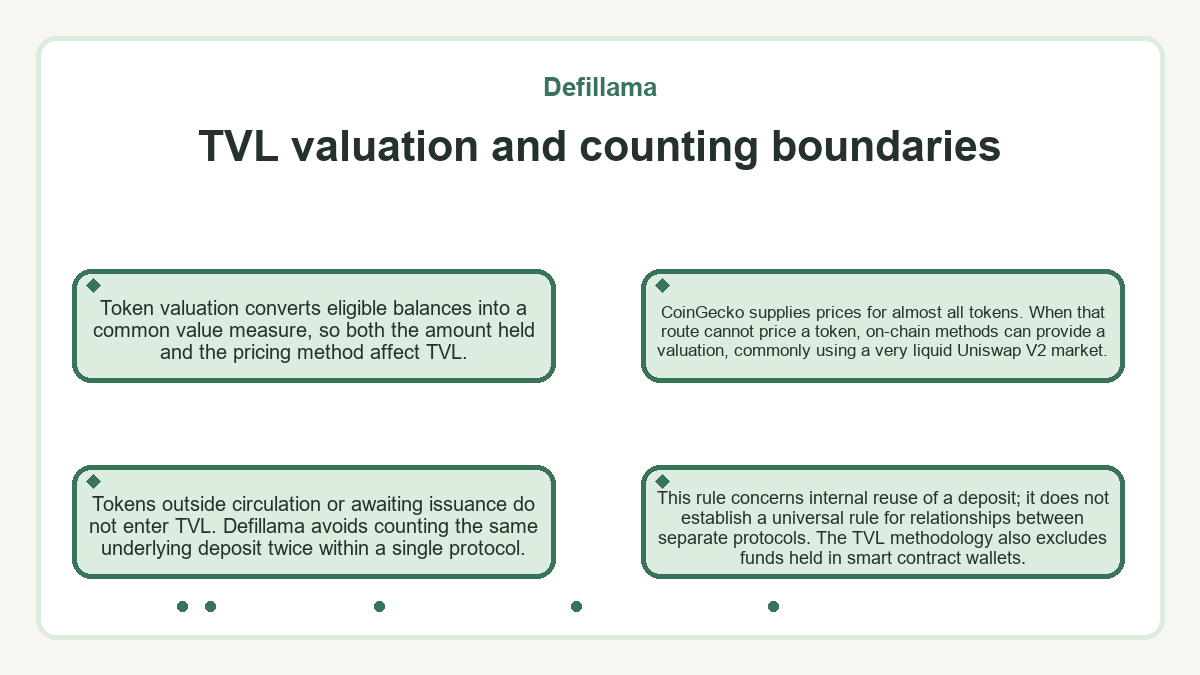
Token valuation converts eligible balances into a common value measure, so both the amount held and the pricing method affect TVL. CoinGecko supplies prices for almost all tokens. When that route cannot price a token, on-chain methods can provide a valuation, commonly using a very liquid Uniswap V2 market. Tokens outside circulation or awaiting issuance do not enter TVL.
Defillama avoids counting the same underlying deposit twice within a single protocol. This rule concerns internal reuse of a deposit; it does not establish a universal rule for relationships between separate protocols. The TVL methodology also excludes funds held in smart contract wallets.
Comparing a deposit with its receipt token
A reader comparing deposit structures asks whether reusing a receipt token increases the capital counted for the protocol. In this hypothetical comparison, an eligible circulating-token deposit has a fixed value of $1468, with no other eligible deposits. One protocol component holds the underlying tokens. Another component of that same protocol holds a receipt representing the deposit, also valued at $1468.
Summing the underlying value and its matching receipt would produce $2936. The comparable TVL remains $1468 because the receipt introduces no additional underlying capital. The calculation applies while both entries represent the same backing inside the same protocol; new deposits or a different token valuation change the amount.
Protocol totals and chain totals
Chain TVL groups capital by network using Defillama's inclusion rules, so it can differ from the total shown for individual protocols. Native token staking, such as ATOM staking to secure the Cosmos Hub, does not count toward TVL. Liquid staking protocols have tracked TVL, but default chain totals exclude them. A protocol can therefore have a measured balance without contributing to the default chain figure.
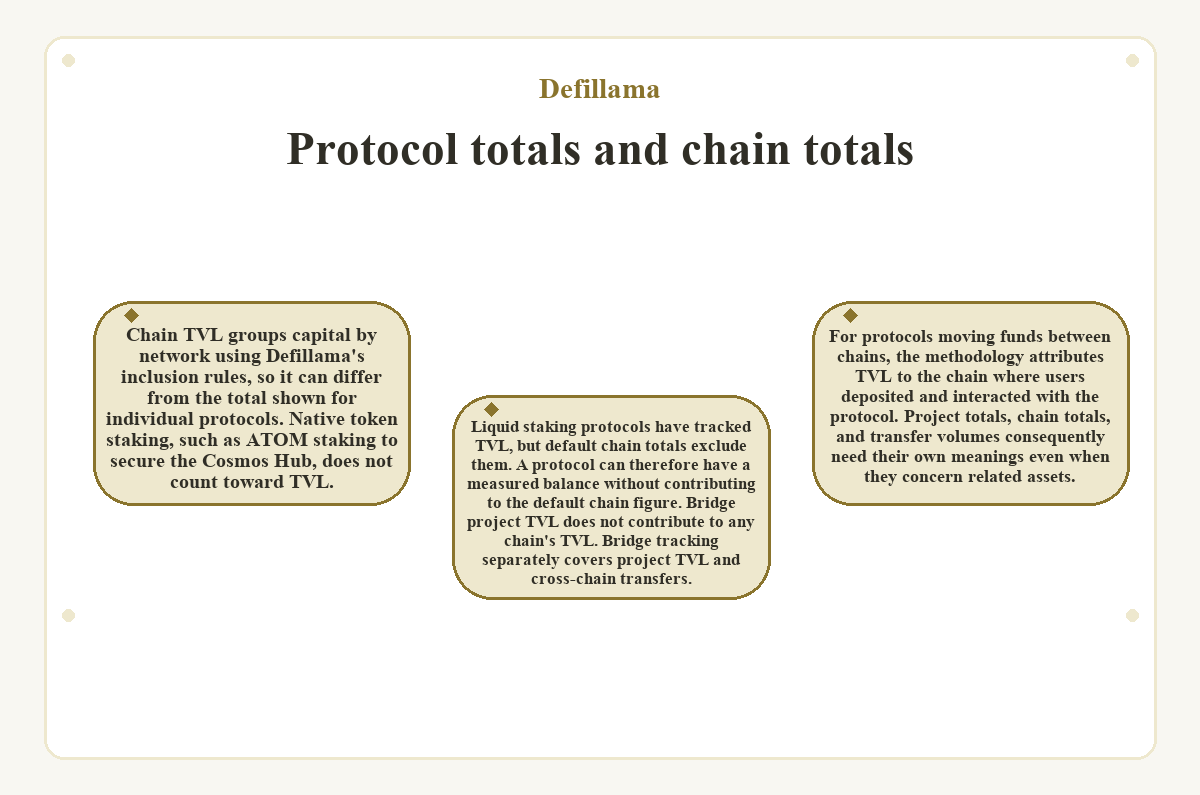
Bridge project TVL does not contribute to any chain's TVL. Bridge tracking separately covers project TVL and cross-chain transfers. For protocols moving funds between chains, the methodology attributes TVL to the chain where users deposited and interacted with the protocol. Project totals, chain totals, and transfer volumes consequently need their own meanings even when they concern related assets.
Yields, stablecoins, and wider asset coverage
Yield dashboards focus on annual percentage yield (APY) and pool-level yield data, while stablecoin datasets track circulating supply and peg behavior. These datasets complement TVL without measuring the same thing. Pool yield expresses an annualized rate, whereas stablecoin supply describes tokens in circulation. A peg concerns a token's price relationship to its target.
Real-world asset (RWA) coverage tracks issued-token value and DeFi usage. Oracle datasets track total value secured (TVS), a separate measurement for oracle providers. Emissions coverage records token issuance and unlock schedules. Token-rights data adds governance, economic, and ownership rights, which amounts and prices alone do not describe.
Coverage also extends to exchange reserves, ETF flows, equities, and Pre-IPO valuations. Equity views include rankings, sectors, industries, and an earnings calendar.
Data access and the wider toolset
Data access includes dashboard views, chart downloads, and an application programming interface (API), supporting analysis and software integration through different entry points. Some charts offer CSV data exports and PNG images. Custom dashboards and a watchlist provide ways to organize selected data. Sheets and Downloads appear within the Premium offering.
LlamaAI adds a question-based interface to DeFi information, while LlamaSearch finds project links and LlamaFeed provides a crypto feed. LlamaSwap is the DEX aggregator in the toolset, covering swaps rather than dashboard analysis. The wider toolset also includes ChainList and a mobile app. Advanced access sits alongside the public dashboard, with Premium features and programmatic data access serving different needs. The applicable subscription and API terms determine which features and datasets an integration can use.
Research uses and coverage limits
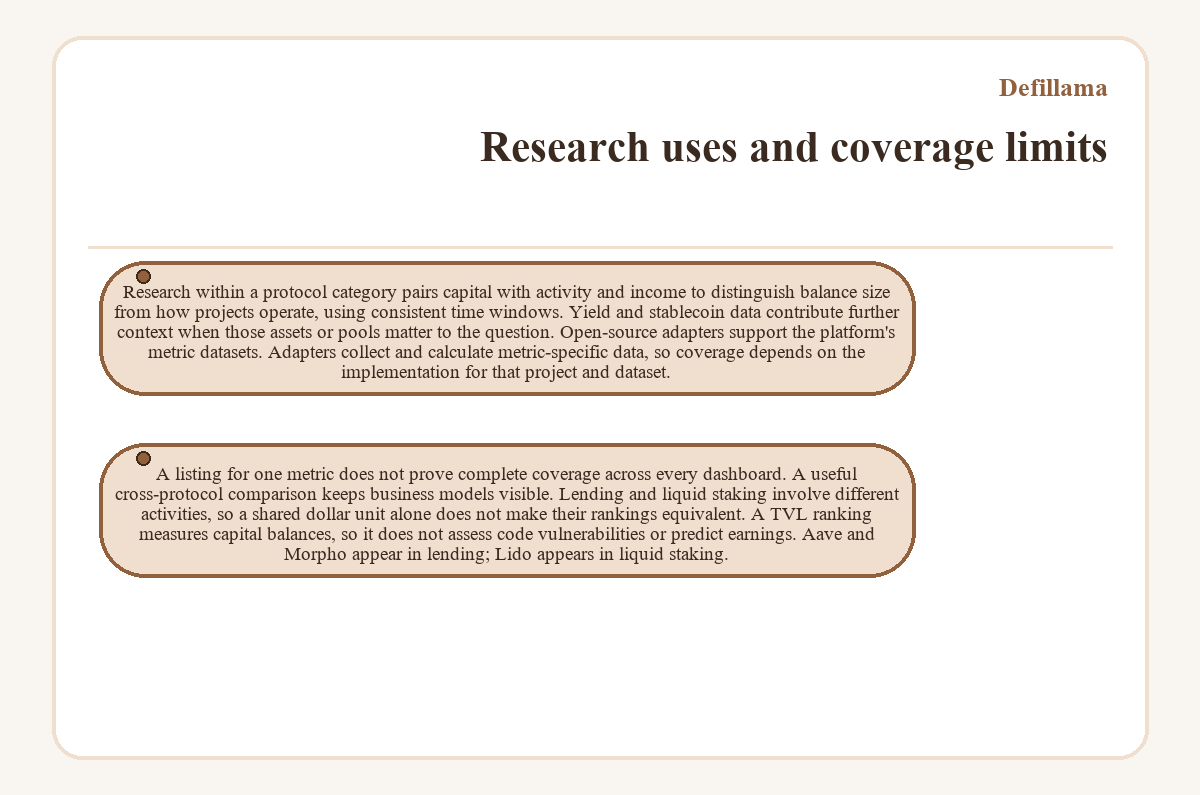
Research within a protocol category pairs capital with activity and income to distinguish balance size from how projects operate, using consistent time windows. Yield and stablecoin data contribute further context when those assets or pools matter to the question.
Open-source adapters support the platform's metric datasets. Adapters collect and calculate metric-specific data, so coverage depends on the implementation for that project and dataset. A listing for one metric does not prove complete coverage across every dashboard.
A useful cross-protocol comparison keeps business models visible. Lending and liquid staking involve different activities, so a shared dollar unit alone does not make their rankings equivalent. A TVL ranking measures capital balances, so it does not assess code vulnerabilities or predict earnings. Aave and Morpho appear in lending; Lido appears in liquid staking.
Good to know
How does a project submit data to Defillama?
For adapter-based metrics, a project submits a contribution to the relevant repository. Real-world asset and token-rights submissions use dedicated forms. TVL, fees and revenue, yields, and stablecoins use different adapter repositories. The contribution concerns a particular dataset, so a TVL submission does not automatically populate every other metric.
Why can TVL move when the number of deposited tokens stays unchanged?
TVL can change because the prices used to value deposited tokens change. A fixed token balance does not have a fixed dollar value when its market price moves. The effect depends on the assets in the calculation and their eligible balances.
Does the fees column show the cost of using Defillama?
The fees column reports economic activity associated with the listed protocol. It describes the tracked protocol's fee or income flows over the labeled period. Dashboard subscription pricing concerns access to analytics, so the column does not quote a price for using the platform.
What does holders revenue measure?
Holders revenue measures value flowing to governance token holders. That value can include buybacks, token burns, direct distributions, and income from external sources. It differs from protocol revenue allocated to a treasury or core team, and it does not always represent cash paid directly to holders.
Can a ranked protocol have TVL without a displayed market capitalization?
A protocol ranking can display TVL while leaving its market-capitalization or token-price fields blank. Those fields measure token valuation, while TVL concerns eligible assets in protocol contracts. A missing token valuation does not make the displayed locked capital zero or identify the cause of the omission.
Is every metric updated on the same schedule?
Metric adapters can use different collection schedules. Some implementations retrieve data for arbitrary periods, while others work with daily aggregates. The displayed update time and measurement window belong to the particular dataset; a recent update in one view does not establish equal freshness across all views.
Are the equities sections limited to companies operating in DeFi?
The equities dataset covers market data for US-listed companies. That scope extends beyond balances in decentralized finance contracts. Pre-IPO coverage separately concerns valuation data for the highest-valued private, unlisted companies, so those entries and their valuation measures belong to a different comparison from protocol TVL.
· updated