 Defillama
Defillama yields - Pool APY Comparison
Defillama yields let you compare reported annualized earning rates across DeFi pools with matching assets and income sources. APY means annual percentage yield, and a ranking orders the estimates the platform reports. A useful comparison distinguishes base earnings from separate token incentives and keeps each pool's chain and deposit exposure in view. The highest displayed percentage can reflect reward payments or a short measurement window. Pool total value locked (TVL) adds size context; a protocol's median APY summarizes tracked pools using TVL weights. Choosing between pools also requires attention to the rate's assumptions, withdrawal conditions, and costs over the intended holding period.
Matching the exposure before ranking rates
Pool comparisons become meaningful when the deposit assets and earning mechanism match the position you intend to hold. Token, chain, project, and category filters narrow the available pool set. Pools sharing a token symbol may hold that asset alone or alongside other tokens, creating different deposit exposures. Each pool's protocol and metadata identify the position the rate describes, including relevant market or strategy distinctions.
Interest-based lending pools earn income from borrowers. Liquidity pools earn trading fees, and liquid-staking positions carry staking-related income. Separately paid incentives can accompany those mechanisms when the pool reports them. Comparing rates across these categories also compares different sources of earnings. Stablecoin pools narrow the asset class, yet their lending or liquidity structures retain different exposures. A pool's metadata may distinguish a market, fee tier, lock duration, or strategy within the same project. These details help explain why two entries with similar token symbols can report different rates.
Borrow rates price a debt obligation. The Earn, Borrow, and Loop views address different positions, so supply APY cannot substitute for borrowing cost.
Base earnings and reward-token income
Base APY describes income from the pool's earning activity, while Reward APY describes separate incentives. Where both components exist, their sum forms the reported total APY.
Income from the deposited position
Supply income in interest-based lending markets responds to borrowing demand and the market's interest-rate model. Trading-fee income responds to activity in the liquidity pool. An annualized base rate therefore reflects the mechanism generating that income. Comparing these rates across otherwise similar pools helps distinguish earnings from the deposited position from additional incentive distributions.
Separate incentive distributions
Tradable rewards
Reward payments can use a different token from the deposited assets. The yield methodology includes reward APY only for incentives paid in tokens already tradable. The reward token's market value affects the economic value of those payments. A change in that value can alter the incentive component without changing the pool's underlying earning mechanism.
Extra holdings and exit conditions
The methodology uses unboosted yields and omits earnings requiring an additional token beyond the liquidity-provider token. It also excludes locked reward distributions. When early exit reduces rewards, the methodology requires the adapter to report the lower attainable rate. A protocol's maximum advertised rate may therefore describe participation conditions the ordinary listing excludes. Matching those conditions matters when comparing a listed rate with a promotional figure.
Recent rates and longer observation windows
Recent APY estimates describe the earning conditions behind the latest sample, while longer windows help reveal short-lived movements. The standard fee-based yield methodology annualizes fees measured over a 24-hour window. A busy trading day can lift that estimate without establishing the same pace for the coming year.
Some rows also offer seven-day Base APY or thirty-day average APY. These fields describe different measurements, and their availability varies by pool.
A base-rate measure covers core earnings; a total APY measure also reflects any included incentives. Comparing them without matching the components confuses the income source with its time window. A pool's history can show rate variability, although an average does not explain every movement. The historical period also differs from the time a prospective deposit would remain in the pool.
Borrowing demand, trading activity, and incentive valuations affect different rate components. A historical pattern cannot establish the future demand or rewards sustaining that rate.
Protocol median APY and individual pool rates
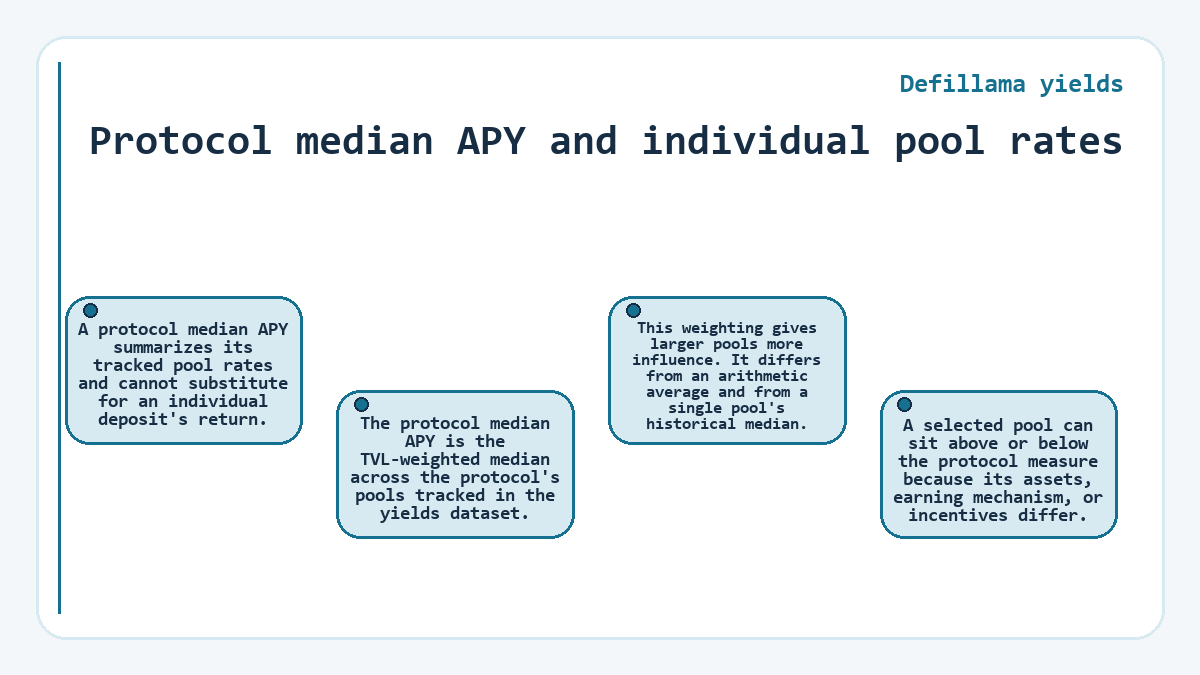
A protocol median APY summarizes its tracked pool rates and cannot substitute for an individual deposit's return. The protocol median APY is the TVL-weighted median across the protocol's pools tracked in the yields dataset. This weighting gives larger pools more influence. It differs from an arithmetic average and from a single pool's historical median. A selected pool can sit above or below the protocol measure because its assets, earning mechanism, or incentives differ.
A shortlist based on the income being compared
To compare earnings with and without separately paid reward tokens, define the acceptable asset exposure and chain first. Start by sorting the matching pools on total APY. Record each candidate's rate and pool TVL; keep entry and withdrawal costs separate. This produces a shortlist based on the full reported income, including incentives where the adapter reports them.
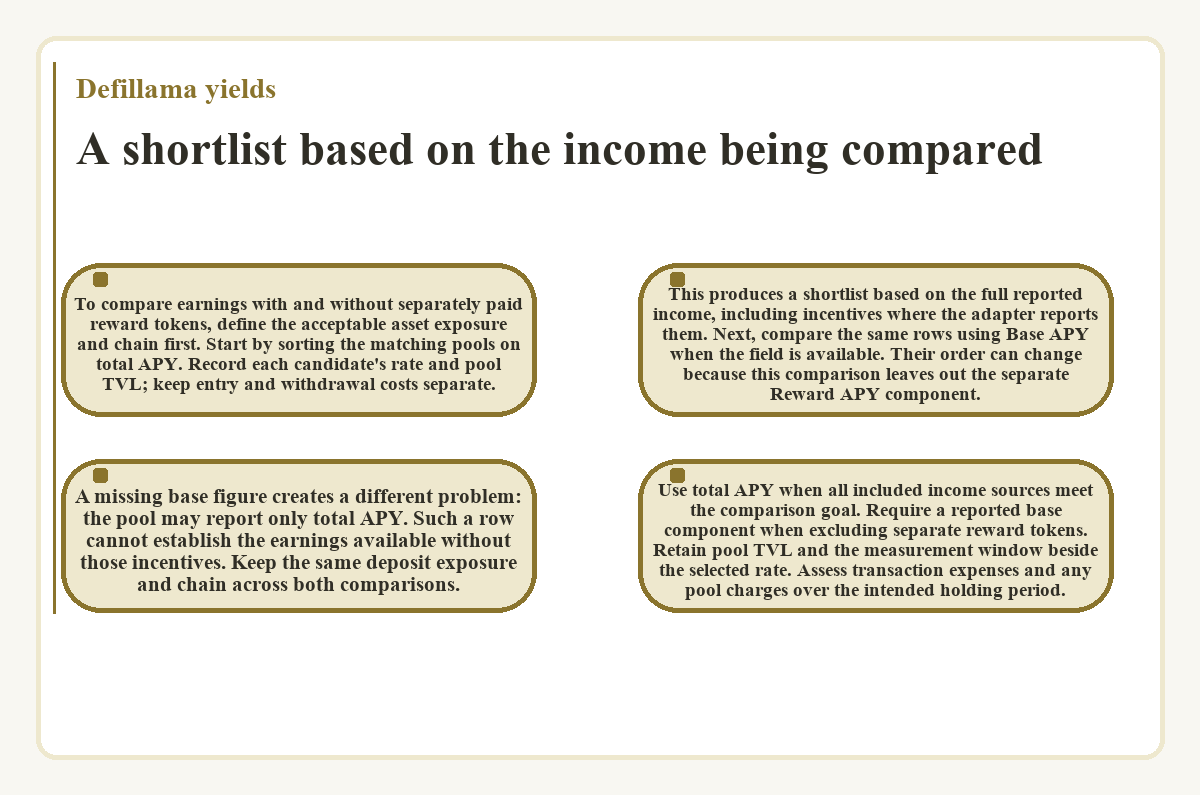
Next, compare the same rows using Base APY when the field is available. Their order can change because this comparison leaves out the separate Reward APY component. A missing base figure creates a different problem: the pool may report only total APY. Such a row cannot establish the earnings available without those incentives.
- Keep the same deposit exposure and chain across both comparisons.
- Use total APY when all included income sources meet the comparison goal.
- Require a reported base component when excluding separate reward tokens.
- Retain pool TVL and the measurement window beside the selected rate.
- Assess transaction expenses and any pool charges over the intended holding period.
Costs, asset exposure, and the withdrawal boundary
A pool's annualized rate leaves the cost of entering, maintaining, and exiting a particular position unresolved. Network charges vary with the chosen chain and transaction. Any deposit, withdrawal, or management fee the selected pool charges belongs in the same cost assessment. The deposit size and holding period determine how heavily a fixed transaction expense weighs against income. Reward collection or reinvestment may add costs when those actions require transactions. A protocol-wide fee total does not establish the cost of those actions for a particular position.
Trading-fee income can coexist with losses relative to holding the underlying tokens, known as impermanent loss. Concentrated-liquidity positions may earn fees only while their range contains the market price. Pool-wide APY does not settle the earnings of every possible price range. Stablecoin pool comparisons also retain exposure to peg failures and the pool's own contracts.
Withdrawability follows the selected protocol's liquidity and position rules. Lending yield adapters report pool TVL as supplied value minus borrowed value. Interest-bearing lending positions can face limited withdrawal liquidity when borrowers use the available assets. If you have an outstanding loan, the protocol may limit collateral withdrawals to maintain its collateral requirements. Those conditions affect access to the deposited assets and belong beside the rate comparison. An APY ranking cannot establish the amount a particular position can withdraw.
Defillama yields: Can You Compare Pools by APY?
- Recent rates and longer observation windows
- Protocol median APY and individual pool rates
- A shortlist based on the income being compared
- Costs, asset exposure, and the withdrawal boundary
Practical questions
How often do pool APY and TVL figures update?
Yield data, including pool APY, borrow APY, and pool TVL, updates hourly. These are periodic observations, so a displayed rate need not match the pool's rate at the exact moment of a transaction. Website caching can also delay the display relative to the underlying data.
Why might a pool be missing from the yield rankings?
The standard yield listing requires pool TVL above $10,000. A pool below that threshold may exist in an adapter without appearing in the listing. Specialized views can impose additional eligibility conditions, and selected filters can further narrow the displayed pools. Absence from a ranking does not establish that the pool has closed.
Is the displayed APY always a compounded return?
The APY label does not always include reinvestment for every listed pool. For pools without automatic compounding, the dashboard does not assume reinvestment and treats the reported rate as APR, or annual percentage rate. Comparing compounded and uncompounded estimates therefore requires attention to the earning mechanism behind each value.
Can I add individual pools to a yields watchlist?
The yields watchlist covers pools tracked in the yields section. It differs from the protocol watchlist, which organizes protocols. Keeping individual pools together supports repeat comparisons of their reported rates and TVL; a protocol entry alone does not identify the particular pool whose yield interests you.
Does an audited-protocol filter certify a pool's security?
An audited-protocol filter does not certify the security of every listed pool. The platform provides analytics and does not perform the protocol audits itself. An audit concerns its specified contracts and scope; pool liquidity, asset exposure, and changing incentives remain separate considerations when interpreting a yield listing.
Can protocol revenue determine a liquidity pool's APY?
Protocol revenue does not supply the pool-level earnings needed to calculate a liquidity pool's APY. Revenue measures the share of fees the protocol retains and excludes payments to liquidity providers. A pool yield calculation needs the income attributable to that pool and its relevant capital basis over the applicable measurement window.
· updated